The Five Layers, one page each.
The complete framework from The Five Layers of AI-Ready Operations - each sheet is a single layer, the tells that reveal you're missing it, and the one Monday-morning move. Free, no email. The version to forward to whoever owns AI where you work. Below the set, the Season 2 studies get the same one-page treatment.
The Five Layers - the complete set
Six sheets, nothing held back: the whole map on one page, then one page per layer. Start with the cornerstone if you are new - it tells you which of the five you are missing in about sixty seconds.
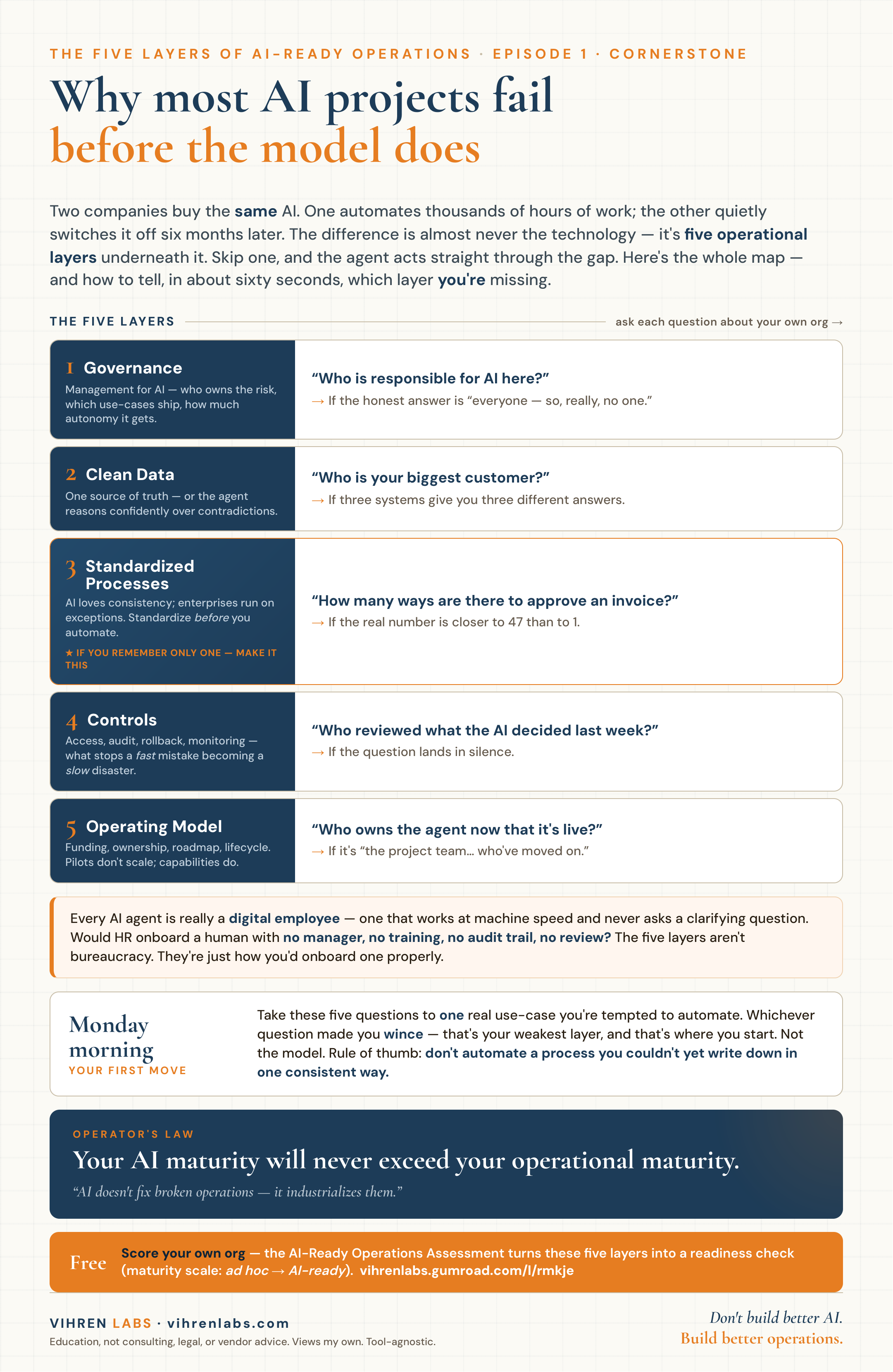
Why most AI projects fail before the model does
The whole map on one page: the five operational layers, and one question for each that shows which layer you're missing.
Download PDF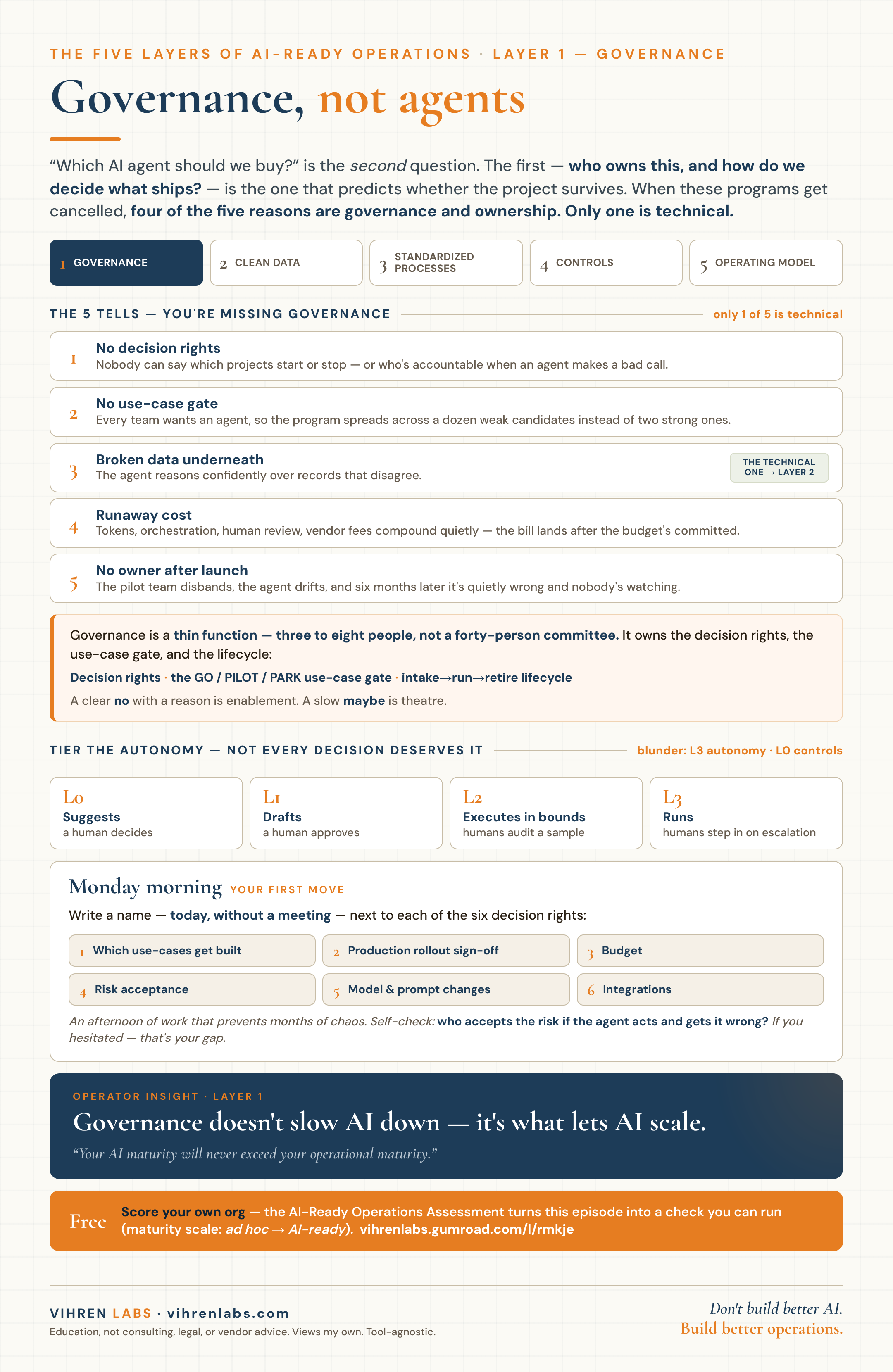
Who decides what ships
The five signs you're missing governance (four aren't technical), the six decision rights to name, and the four levels of autonomy.
Download PDF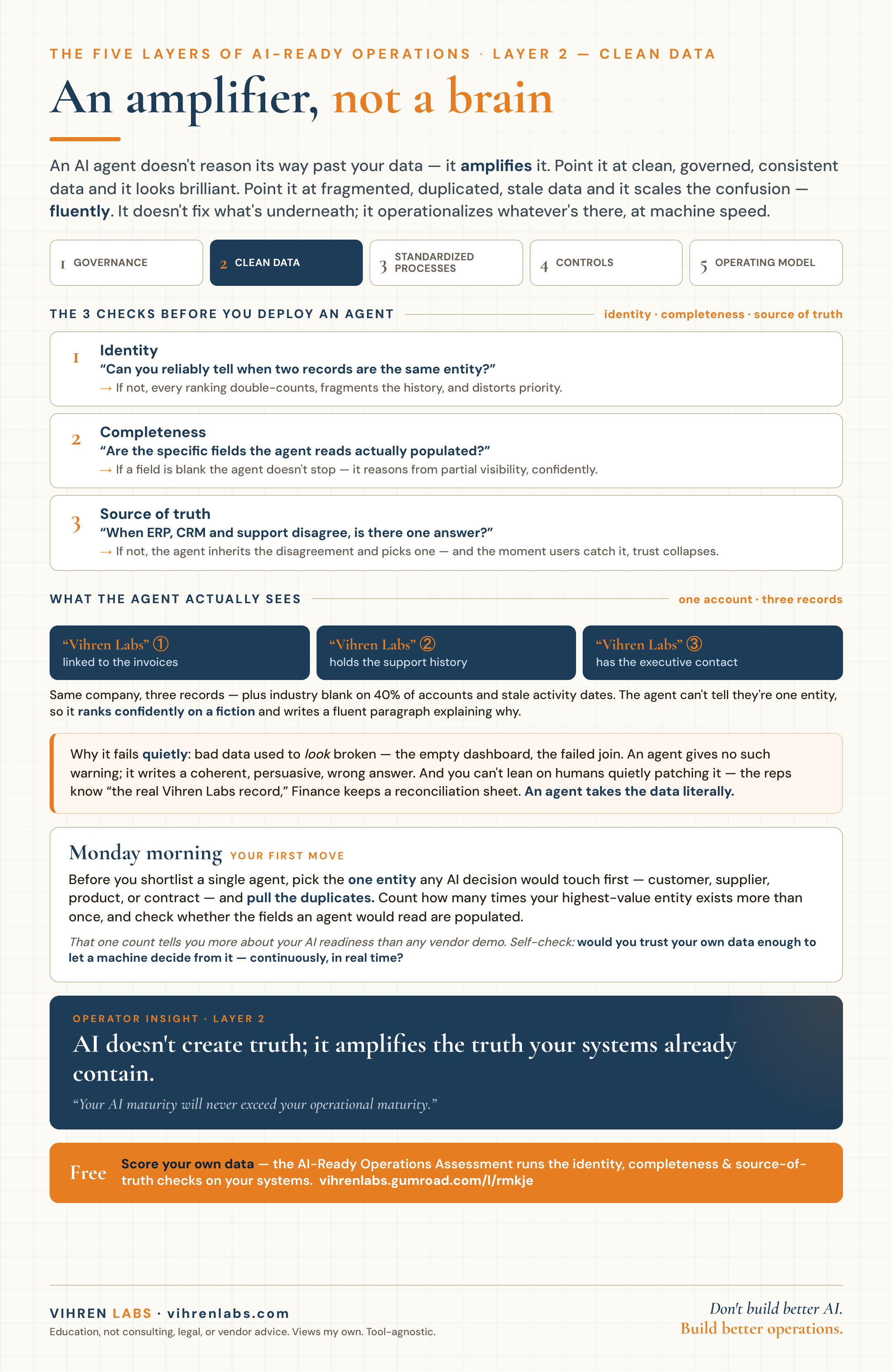
Agents run on your data
The three checks to run before you deploy an agent (identity, completeness, source of truth), and why wrong answers built on bad data are hard to spot.
Download PDF
Write the exceptions down
The four moves that actually standardize a process, the two things an agent does with an exception nobody wrote down, and the count that tells you whether you are ready.
Download PDF
Controls before autonomy
The five controls an agent needs on day one (access, audit trail, rollback, monitoring, a person checking its work), and the autonomy dial that sets how much it does on its own.
Download PDF
Who runs it after launch
Building an AI system is a project, and keeping it valuable is ongoing work. The five pieces that keep a pilot that worked running after launch: funding, an owner, a roadmap, running it day to day, and retiring it.
Download PDFAll five layers plus the cornerstone. Nothing in this set is coming later - it is finished.
The numbers everyone is arguing about
Same one-page treatment, applied to the studies and headlines rather than the framework: what the number actually measured, where the failure really sat, and the move it argues for. One for each of the season's nine episodes.

95% of AI pilots fail. What the other 5% did.
What the MIT study actually said: the three root causes behind the 95%, and why each one is about the operation around the model.
Download PDF
Five levels. Where you actually sit.
The 5x5 matrix on one page - ad hoc to AI-ready on every layer, the level-three line you should not automate below, and the rule that decides your score: your readiness is the lowest of the five.
Download PDF
Why proofs of concept get scrapped
The 42% jump and the 46% underneath it, where scrapped pilots stop (governance and the operating model), and three questions to answer before the next green light.
Download PDF
Same 13%. Three years of spending.
Cisco's three-flat-years finding decoded - the 4x pilot-to-production gap, the 54% whose networks cannot carry the load, and the double-the-budget test that tells you whether money would change anything at all.
Download PDF
An AI CoE that can say no
The anatomy of an AI CoE on one page - what it owns versus what it only advises on, the funding test that decides whether it can refuse at all, the three artefacts that make it auditable, and the four ways it quietly stops governing.
Download PDF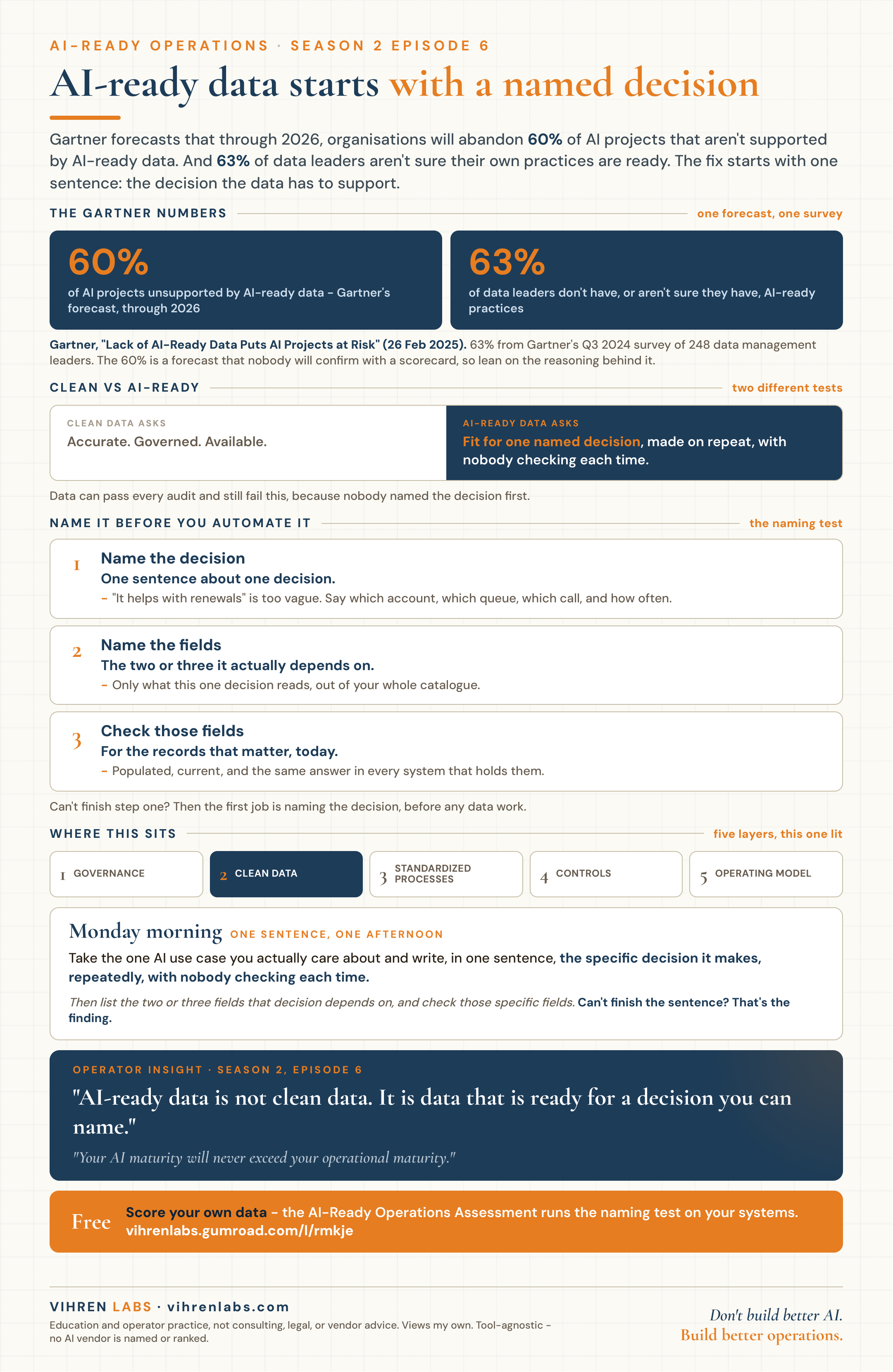
AI-ready data starts with a named decision
Gartner's forecast that 60% of AI projects without AI-ready data will be abandoned, the 63% of data leaders who lack AI-ready practices or aren't sure they have them, and the three-step naming test to run before you automate a decision.
Download PDF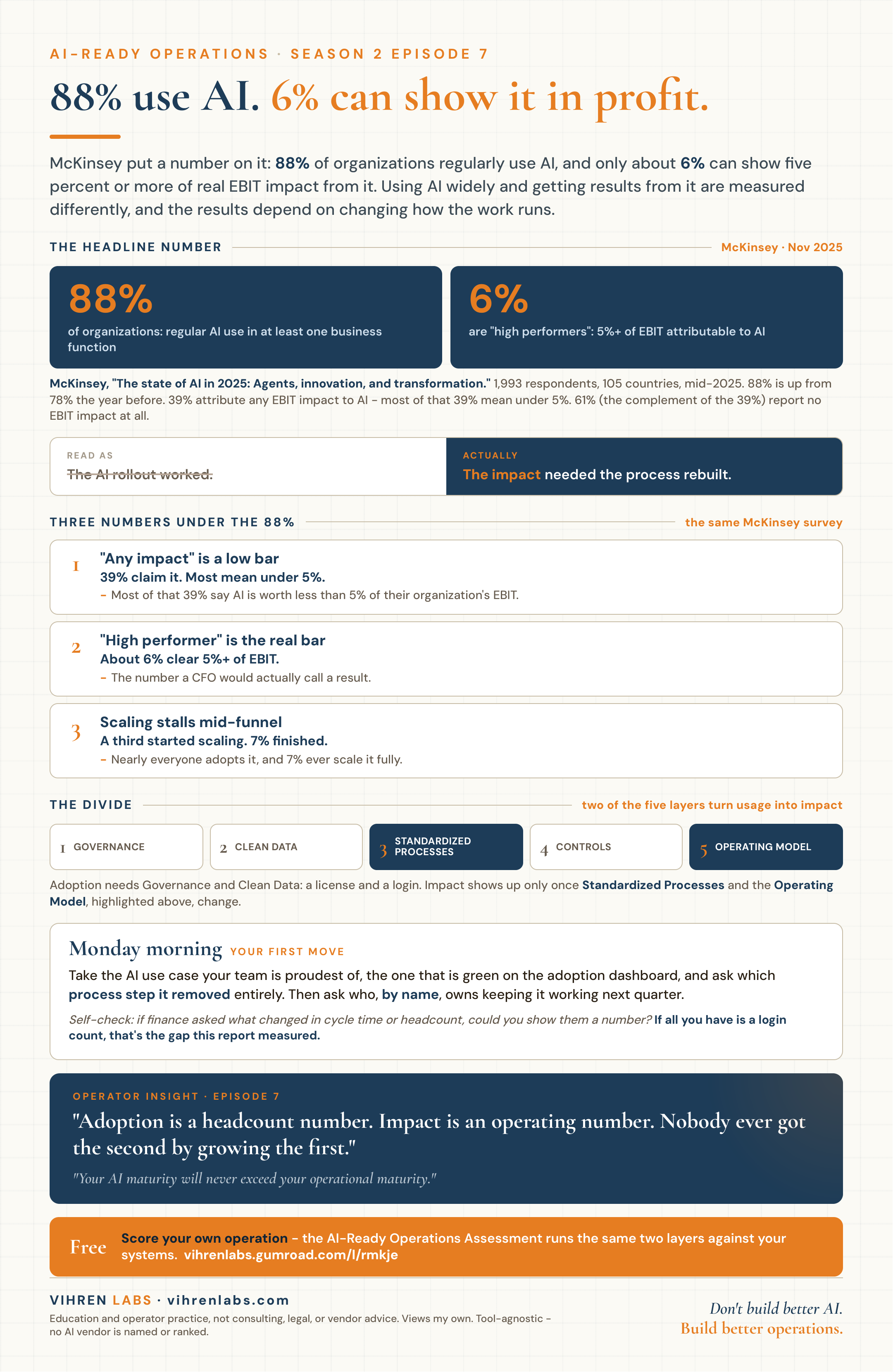
88% use AI. 6% can show it in profit.
McKinsey's 2025 survey on one page: 88% use AI, 39% report any EBIT impact, about 6% get 5% or more of EBIT from it, and the two layers that turn usage into impact.
Download PDF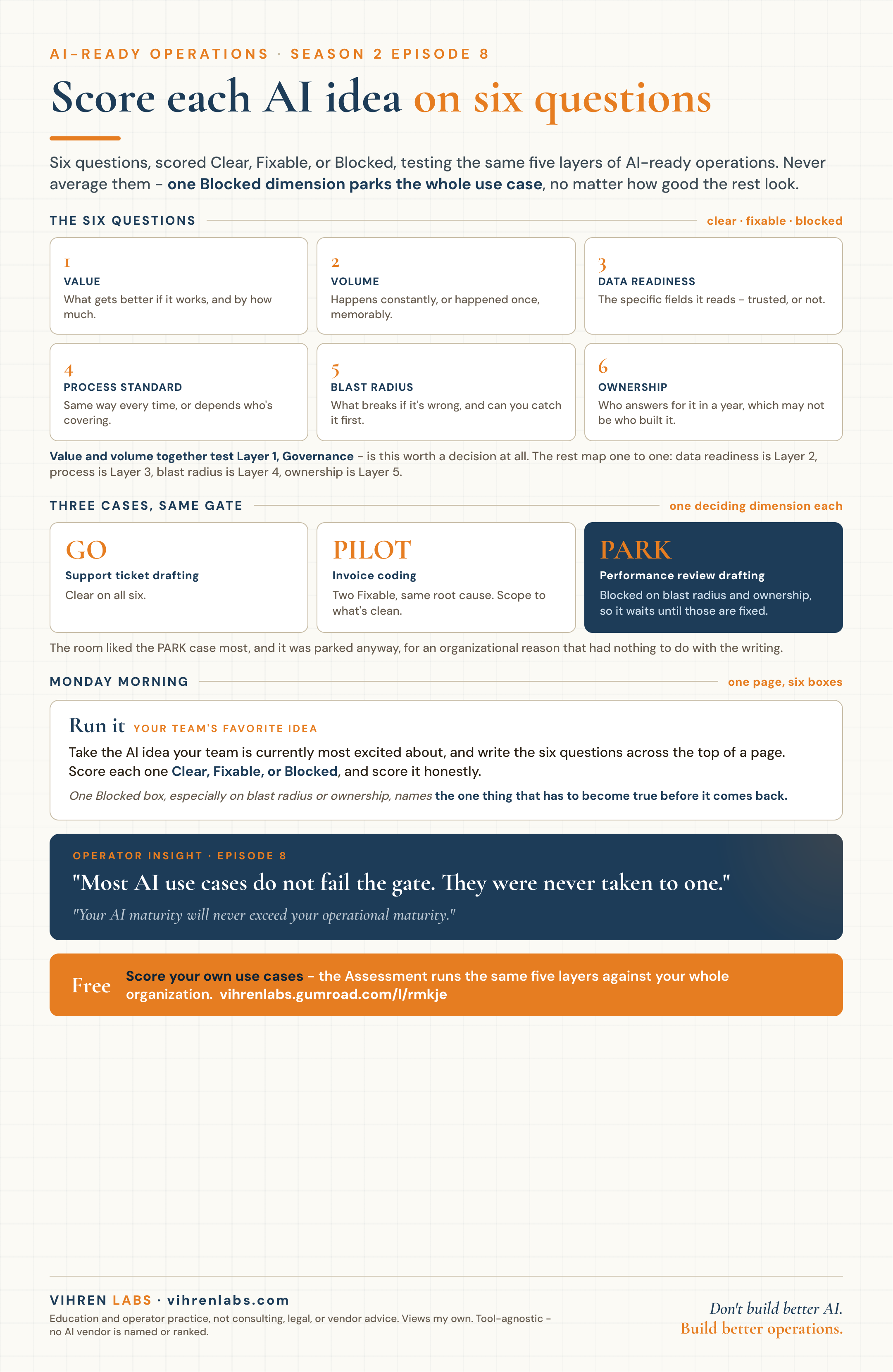
Score each AI idea on six questions
Six questions scored Clear, Fixable or Blocked, the rule that one Blocked answer parks the whole idea, and three worked cases: one GO, one PILOT and one PARK.
Download PDF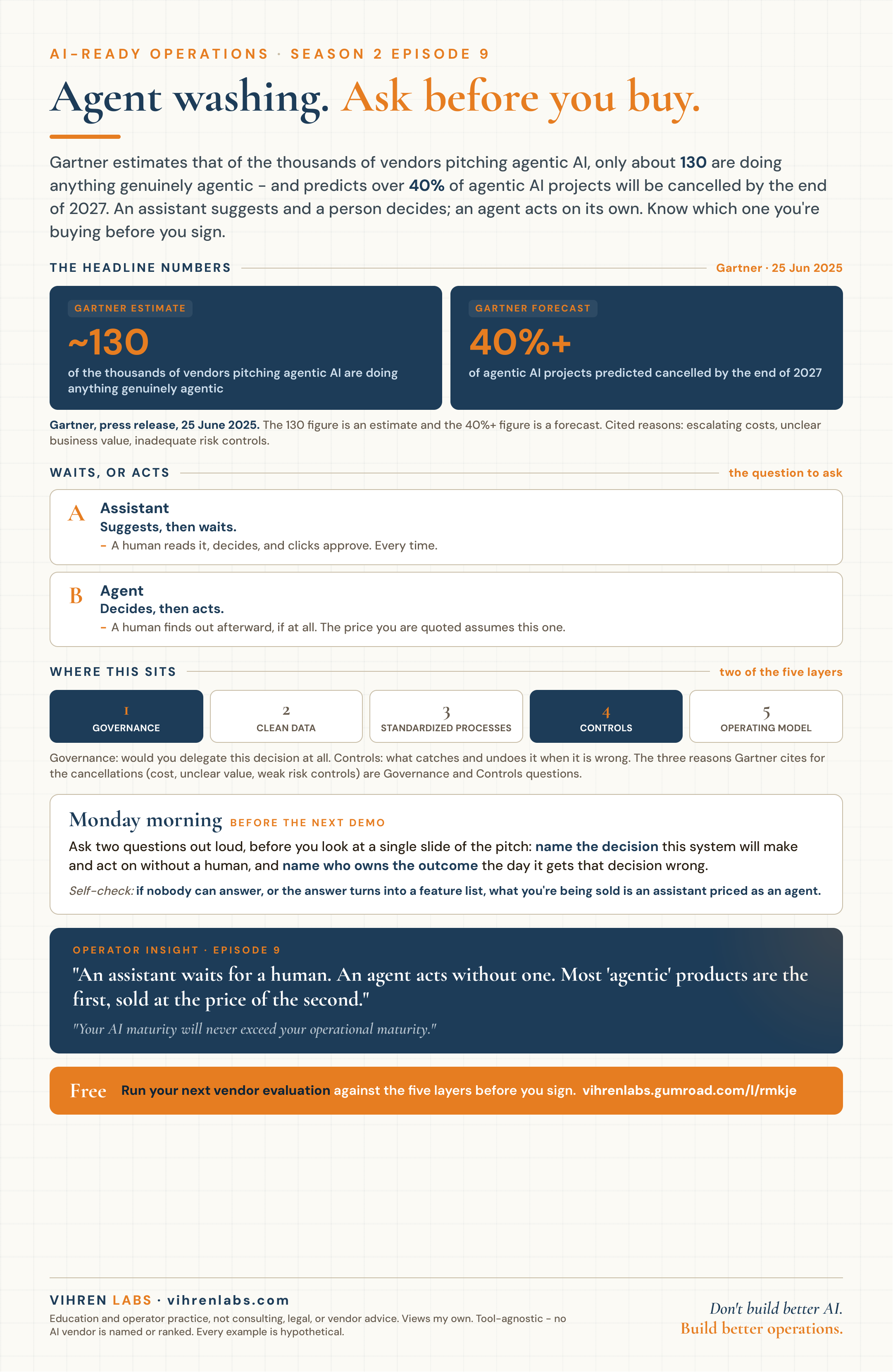
Agent washing. Ask before you buy.
Gartner's estimate that only about 130 of the thousands of vendors selling agentic AI are genuinely agentic, the question that tells an assistant from an agent, and the two questions to ask before the next demo.
Download PDFAll nine episodes are here, one sheet each. Subscribe to the newsletter, or watch the season.
Want all five in one go?
Get the whole framework - scored on your own org.
Grab the sheets one at a time above - or get the whole thing in one place. The free AI-Ready Operations Assessment turns all five layers into a readiness check you run on your own organization - a maturity scale from "ad hoc" to "AI-ready" that shows your weakest layer before you spend a cent on tooling. Enter your email and it lands in your inbox.
Get the free assessmentFree · straight to your inbox · no spam
Education, not consulting, legal, or vendor advice. Tool-agnostic. Go deeper: the Master Data Operator's Pack, the AI Adoption & Governance Operator's Pack, or the full operator library